Resolving the Future of Empathic AI Scams: A Nigeria-UK Collaboration
Project Overview: AI as a "Force Multiplier"
Artificial Intelligence is no longer a future threat; it is currently acting as a "force multiplier" for criminal enterprises. By automating tasks and exploiting human psychological vulnerabilities with unparalleled precision, AI is fundamentally altering the risk-reward calculus of cybercrime.
The Challenge: Moving from traditional "419" or romance scams to AI-augmented deception.
Our Idea: We view this not just as a security issue, but as a socio-economic challenge that requires capacity building and ethical governance.
Socio-Economic Drivers in Nigeria
There are no simple solutions to scam culture, but we think that cybersecurity and legal solutions should factor for Nigeria's social landscape.
Economic Precarity: With 58% of the population under 30 and facing high unemployment, many tech-savvy youth see cybercrime as a survival mechanism.
Sociological Context: Scamming is embedded in complex historical, colonial, and social narratives. Understanding the modern role of these narratives is vital for developing effective, long-term interventions.
Talent Diversion: Scam cultures funnel digital literacy away from the legitimate economy, creating a self-reinforcing cycle of poverty and reputational harm.
Research Team
This project is a 3-month sprint led by social scientists and AI specialists.
Vian Bakir: Professor of Political Communication and Journalism, Bangor University.
Andrew McStay: Professor of Technology & Society, Bangor University.
Chiemezie Ugochukwu: Law and Social Justice, Bangor University.
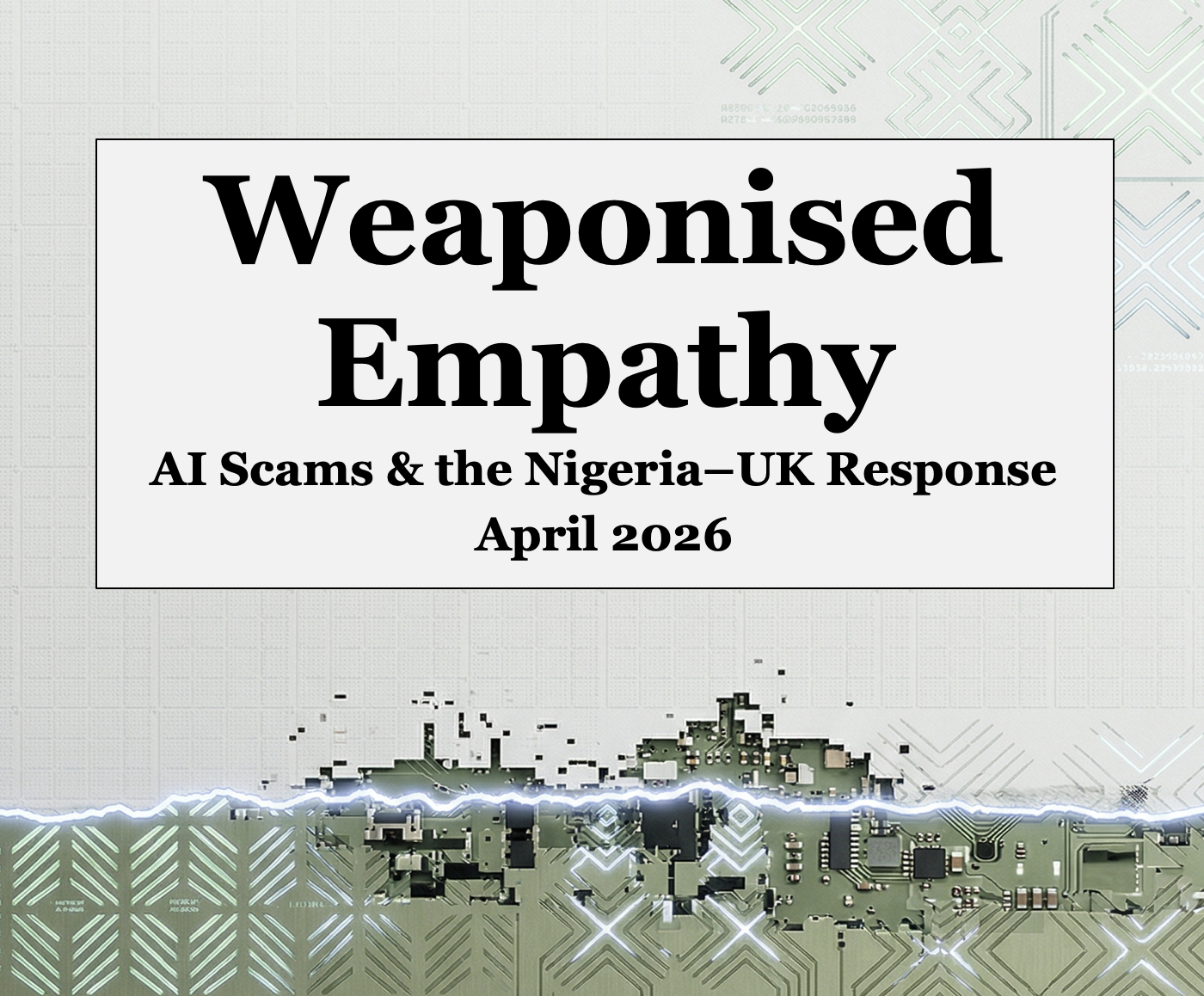
New report: Weaponised Empathy — AI Scams & the Nigeria–UK Response (April 2026)
The Mechanics of Empathic Scams
"Empathic technologies" are systems designed to recognize, interpret, and respond to human emotional states. In the hands of scammers, these become weapons for "industrialized social engineering". Key tactics include:
Voice Cloning: Using small audio samples to impersonate family members or authority figures.
AI Chatbots: Conducting autonomous, human-like conversations across messaging platforms without fatigue.
Vibe Coding: Utilizing "low-code" or "no-code" AI development to lower the technical barrier for entry into cybercrime.
Deepfake Video: Creating fake endorsements from celebrities or trusted figures to build false trust.
What we’re doing
Literature Review: Analysing existing research on Nigerian scam culture and its historical roots.
Technological Mapping: Identifying how empathic AI, voice cloning, and "vibe coding" are being deployed in scam ecosystems.
Psychological Analysis: Examining the emotional and social-engineering strategies that underpin AI-enabled scams.
Fieldwork & Workshops: Engaging with policymakers, academics, and community leaders through workshops in in Abuja and at Nnamdi Azikiwe University (UNIZIK) in Awka.
Stakeholder Interviews: Consulting with UK regulators like the ICO and FCA, as well as "Tech for Good" incubators and VC investors.
Collaborative Policy Development: Co-developing recommendations with Nigerian and UK partners to inform public education and national fraud strategies.
Get Involved!
Are you a regulator, in industry, or an academic working on scams? Have we overlooked you? 😮 If you have a view or research you’d like share, and/or you’d like a chat, we want to hear from you. Pop Andrew a message (mcstay@bangor.ac.uk).