Emotion, attention and trust: AI and Nigerian journalism ahead of the 2027 elections
Keynote at “The Future of AI in Journalism in Nigeria”, 18 November 2026, online
Nigerian audiences trust their news more than almost anyone else in the world. With a presidential election weeks away, that trust is about to be tested, by people and by machines.
That was Vian Bakir’s message in her keynote at “The Future of AI in Journalism in Nigeria”, a one-hour online workshop for journalists and students at the Nigerian Institute of Journalism (NIJ) in Lagos. It was organised by Ighodalo Uyi Ebhodaghe, Vian and Andrew’s MA by Research student at Bangor University, with Paradigm Communications Limited, publishers of National Daily newspaper. It drew 100 registrations and 44 attendees, mostly practising journalists and journalism students in Nigeria.
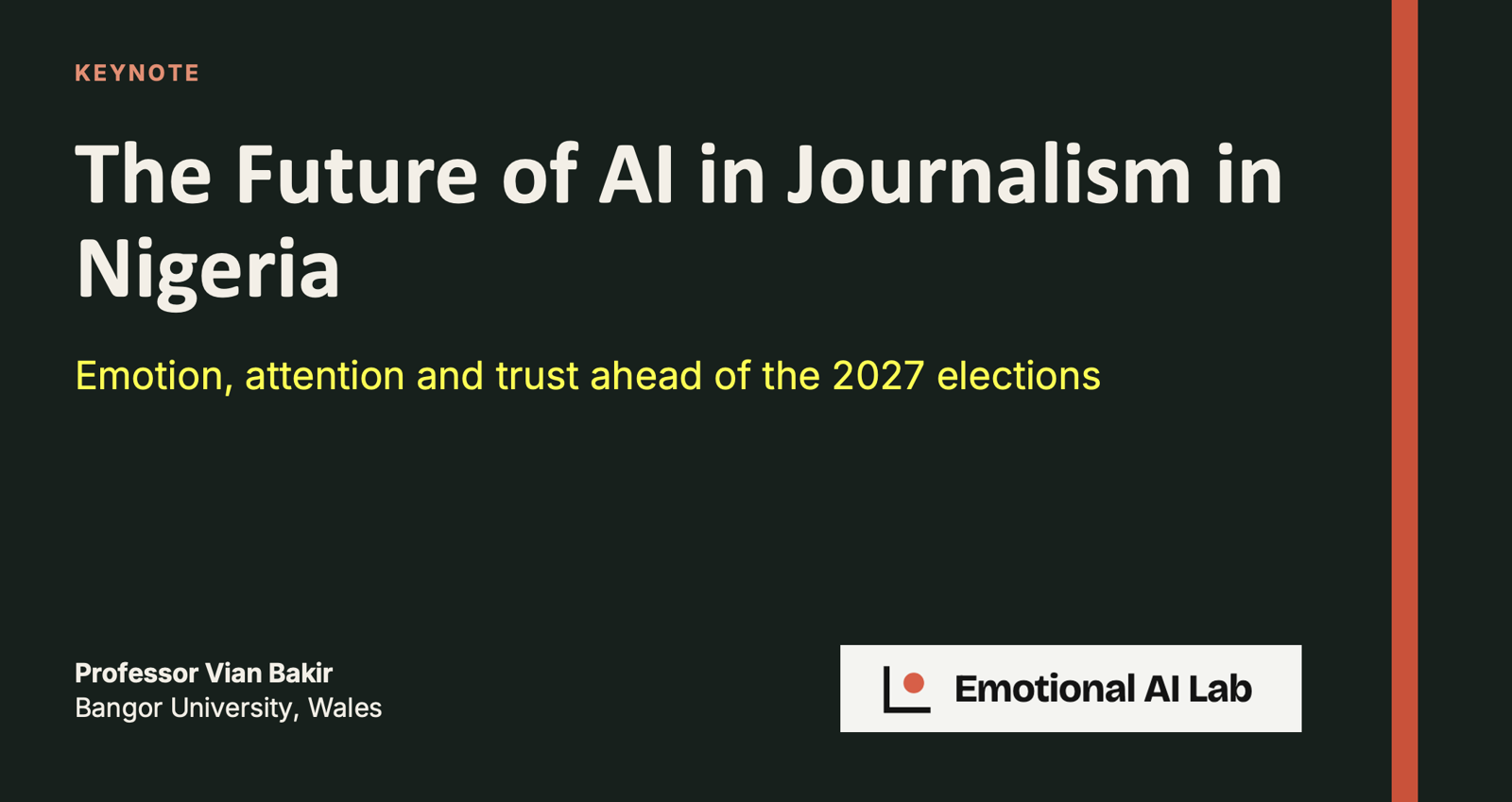
Trust is an asset. Others want to spend it
In the Reuters Institute’s Digital News Report 2026, 68% of Nigerian respondents say they trust most news most of the time. That puts Nigeria joint top, with Kenya, of 48 countries. The global average is 37%. (The Nigerian sample skews young, English-speaking and online.) With polls on 16 January 2027 and campaigns under way, that trust is a prize.
Emotional AI doesn’t feel. It guesses
Emotional AI tries to read our feelings from our words, voices, faces and bodies, then reacts. You meet it in in-car cameras that watch for tired drivers, “stress” scores on fitness watches, and chatbots built to sound caring.
Its biggest home, though, is your social media feed, which learns from every pause, emoji and share. As Optimising Emotions, Incubating Falsehoods (Bakir & McStay, 2023) argues, social media is the world’s dominant use of emotional AI.
The science is shaky, especially for tools trained on other countries’ data and languages. It hardly matters. A feed doesn’t need to know how you feel. It only needs to know what keeps you scrolling.
Outrage pays
This is the economics of emotion. By 2017, leaked documents show, Facebook’s ranking counted an “Angry” reaction as worth five “Likes”. In 2019 its own data scientists found that posts drawing angry reactions were disproportionately likely to be misinformation, toxic or low quality. When Facebook cut the weight of Angry to zero in 2020, people saw less false information. The same logic bankrolls fake news sites set up purely for advertising income.
Fear wins votes, but not always
The politics of emotion turns the same techniques to political gain, and Nigeria has seen it up close. Whistleblowers say a Cambridge Analytica-linked video targeted Buhari-supporting areas in 2015, designed to frighten voters into staying home. Yet, as Shola Olabode shows in the Routledge Handbook of the Influence Industry (Briant & Bakir, 2025), it had limited success: cultural loyalties and people’s own judgement pushed back. Manipulation is real, but it is not all-powerful. Reports of paid influencers in 2019, and the alleged work of the “Team Jorge” disinformation firm, show the playbook keeps evolving.
Generative AI makes it cheap. In a 2023 NewsGuard test, ChatGPT turned 80 of 100 known false stories into convincing articles or scripts. At a BudgIT event in Lagos in March 2026, speakers warned that AI lets campaigns send each voter a different message: the economy for one, religion and culture for another.
Deepfakes cut both ways
False information leaves people wrongly informed, spreads emotional falsehoods at speed, and eats away at trust in the institutions an election depends on. Nigeria saw all three in 2023. On the eve of the presidential vote, a viral audio clip claimed to show opposition figures plotting to rig the election; fact-checkers found it had been doctored. After the vote, an audio clip of another candidate was called a deepfake by his camp and genuine by others.
That is the “liar’s dividend”. Fakes look real, and real recordings become easy to deny. The deeper danger isn’t that people believe lies. It’s that they stop believing anything.
Five things for newsrooms to do before polling day
- Treat strong emotion as a warning sign. If a clip makes you furious or afraid, slow down. That feeling is exactly what it was built to produce.
- Plan for audio. Dubawa’s fact-checkers say audio is among the hardest content to verify on deadline, and detection tools are often poorly trained on Nigerian languages and accents. Line up voice and language experts now.
- Watch the closed spaces. Much of this spreads on WhatsApp. Set up tip lines so audiences can forward what they see.
- Get ahead of the fakes. Before election day, show audiences what a fake result sheet or a cloned voice looks like. People resist a trick better once they’ve been warned about it (“pre-bunking”).
- Show your working. Say how you verified a story and what you still don’t know. When anything can be faked, method earns trust.
Two questions for every AI tool in the newsroom
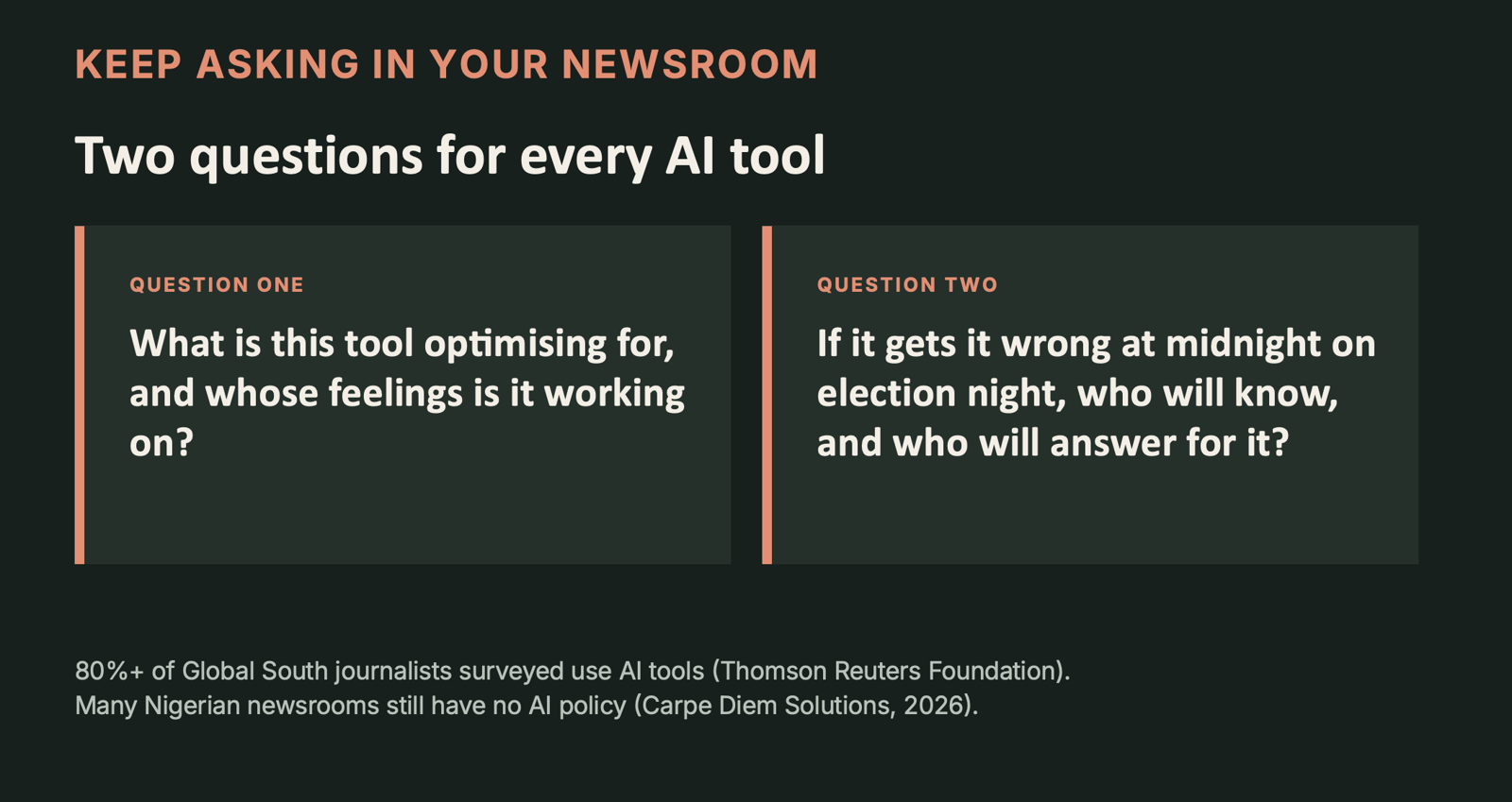
AI is moving into Nigerian newsrooms, often with no editorial policy to guide it. Keep asking:
- What is it optimising for, and whose feelings is it working on? Clicks, time spent, shares, speed? A headline tool tuned for clicks will learn to lean on fear and outrage, just as Facebook’s ranking did. If you can’t find out, that is a red flag.
- If it gets it wrong at midnight on election night, who will know, and who will answer for it? Know which stories AI touched. Name the person who checks its output. Be ready to tell your audience. Accountability is what earns trust.
The full programme
- Opening remarks: Mr Olufemi Osuntoki, Head of Department, NIJ
- Moderator: Ighodalo Uyi Ebhodaghe
- Keynote, “Emotion, attention and trust ahead of the 2027 elections”: Prof. Vian Bakir, Bangor University
- Newsroom perspective: Dr Jide Johnson, NIJ
- Journalists as active editors and ethical gatekeepers: Tobore Imarah, Microsoft
- Practical session on checking AI-assisted content: Ighodalo Uyi Ebhodaghe
- Questions and answers
- Closing remarks: Ambassador Sylvester Ebhodaghe, Paradigm Communications Limited / National Daily newspaper
Further reading
- Bakir, V. & McStay, A. (2023). Optimising Emotions, Incubating Falsehoods: How to Protect the Global Civic Body from Disinformation and Misinformation. Palgrave Macmillan.
- Briant, E. & Bakir, V. (eds) (2025). Routledge Handbook of the Influence Industry. Routledge.
- Bakir, V. & McStay, A. (2018). Fake news and the economy of emotions. Digital Journalism, 6(2).
- Reuters Institute (2026). Digital News Report 2026.